This website is translated into:
Norwegian:
www.barfothest.com
Dutch: http://www.paardnatuurlijk.nl/
barefoot
Swedish: http://www.barfotahast.has.it
Slovenian (in part): http://
www.konji.com
A Slovenian horse care forum http://barefoot.forumotion.com
Spanish: http://www.alexbrollo.com/
alexandra.html
Italian: http://www.alexbrollo.com/alexandra.html
German
http://www.arianereaves.de
There are two French websites: http://achevalpiedsnus.free.fr
and: http://www.cheval-sans-fers.com
Czech (in part): http:/
/www.kopyta.com
/
Finnish: http://www.kengattomathevoset.fi
Croatian (in part): http://
www.epona.hr
Russian (in part): http://www.filly.msk
.ru/articles/health/barefoot1.htm
I invite other translations.
Reasons for going barefoot, and for trimming hooves
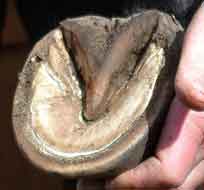
The hoof is not like a solid block of wood. It is an exquisitely designed,
flexible, shock-absorbing, living organ. It is made up of:
-- a crescent-shaped bone, at the bottom of the column of leg bones,
-- entirely covered by soft tissue (called the corium) with a LOT of blood supply,
-- entirely covered by a tough outside layer (wall and sole) to protect the inside
from hard knocks and abrasion.
The back part of the hoof is made up of:
-- the frog, a pad that does the same job as the biggest pad in a cat's or dog's
paw -- a soft landing;
-- the digital cushion, a tough, fibrous, shock-absorbing "hammock" above the frog,
to protect the pastern bones in action;
-- and a W-shaped structure (heels plus bars) that expands sideways when weighted,
for shock absorption.
The REASON for keeping a horse barefoot is:
-- to allow the hooves to flex at every step,
-- to get the most possible blood circulation inside the hoof;
-- to have the most possible shock absorption for the leg joints.
The REASON we trim hooves is NOT to make them look nice! -- though a healthy,
well-trimmed hoof is certainly beautiful. We trim hooves (when the horse does not live and
work on the dry, abrasive ground its feet are made for) so that they do not get overgrown,
and to help them keep a correct shape and size.
-- so that the coffin / pedal / P3 bone is almost level ("ground-parallel"), with its heel
raised 2 or 3 degrees of angle higher than its toe, when standing on a level surface
-- to keep the toe, which grows forward, backed-up to the correct breakover position,
so that the leg has time to fully extend forward and the foot can then land heel-first
onto its shock-absorbing heel structures.
-- to prevent flaring (stretched white line) at the bottom of the wall, which is
painful and leads to mechanical founder.
Things to consider in deciding to
go barefoot.
It has become clear from widespread experience
since 2000 that success in going barefoot is
not just about pulling the shoes
and using the "wild horse" or "high-performance" barefoot
trim. Equally important for barefoot success are:
-- The horse's nutrition, as well as stomach
ulcer prevention, including 24 hours available hay
or forage, with attention to the amount of sugars
in the feed and hay, because many horses become
insulin resistant over time (see
www.safergrass.org.) High sugar
hay, and stomach ulcers, cause damage to the white
line (connection between hoof wall and
coffin/pedal bone).
-- 24 hour turnout, or as much as you can arrange
in your boarding situation (see websites on
"paddock paradise"). Population density near the cities
means that stable properties are getting smaller, so horse
owners need to make extra effort to get turnout for their
horses. Hooves need continual movement for health and healing.
-- Correct and timely care of teeth, using the
techniques of modern horse dentistry that balance
the jaw and the TMJ (temporo-mandibular joint,
where the jaw hinges to the skull). Imbalance in
the jaw and TMJ can result in poor back muscling,
irregular leg movement, and imbalanced wear of the
hooves.
-- Correct saddle fit. Pain from a poorly fitting
saddle can cause incorrect movement, leading to
imbalanced wear of the hooves.
We have had excellent results using barefoot to
rehabilitate foundered horses to full
soundness and rideability (see Founder page). The
wild-horse barefoot trim re-balances the
navicular foot for healing of inflamed
tissues. (see More Topics, Breakover, and Do Trim
pages).
Due to damage inside the shod hoof, it can take as
long as a year after you remove the shoes --
called the "transition year" -- to
rebuild internal tissues and grow out a high
quality, tough hoof wall that is well attached to
the coffin / pedal bone (P3). While this may seem
like a long time, if you leave the shoes on, the
hoof will not have a chance to heal at all,
resulting in the loss of many useful years of life
for the horse.
Hoof boots are a standard and recommended
tool for the transition from shod to barefoot. For
the first several months after pulling the shoes,
horses should use front hoof boots for riding.
Some will need boots during the entire
"transition" year, especially those that
work on paved or gravel roads, rocky trails, or frozen ground,
to protect sensitive internal tissues
while they heal.
Horses that live on soft footing, or are insulin
resistant (IR), may always need hoof boots for
riding on rough or hard surfaces. Horses that work
on paved roads should use boots on all four feet,
to prevent excess wear of their hooves; pavement
is very abrasive.
Hoof boots are getting better every year. When I
started this website in 2000, the only boot
available was the original Easy Boot, which was
less than an ideal design. In 2014, there are
perhaps a dozen very good boots and glue-ons that
I know of (including greatly improved Easy Boots),
and likely another dozen that I have not heard
about. I recommend searching the Internet.
Horses that work on soft arena footing can
be sore from lack of concussion. They should be
walked 10 minutes on a firm surface before and
after the arena work to relieve congestion in the
hooves. The hoof is "designed" to go on firm
ground so that it flexes at every step, causing
ample blood supply inside the foot.
Many of us live in "horse-unfriendly"
climates.
If the annual rainfall where you live is more than about
30 inches (75 cm), the ground is too soft for hooves to
get sufficient concussion and wear. This means
we have to take extra care to help their feet stay healthy,
more than for horses that live in "horse-friendly" climates
where the rainfall is less and the ground is hard and dry.
A shorter time between trims, the quality of the trim, and the
use of hoof boots for riding on rocky trails become extremely
important in rainy climates or during rainy times of the year.
In many areas, if you want a good barefoot trim,
you will need to learn to do it yourself. It is
not hard to learn to trim. This website has
instructions (see Do Trim page), and I also
recommend
www.ironfreehoof.com. There are
barefoot trimmers and hoof schools listed on the
websites in my Contact box, above, who can help
you learn.
How the typical "pasture
trim" makes horses sore
While some thoughtful farriers are helping their
clients go barefoot, others have not yet learned
how to do the wild-horse trim, which differs in
important ways from the conventional "pasture
trim," where
-- The toe callus is trimmed away; then the
thin sole cannot protect the coffin (pedal, P3)
bone.
-- The bottom of the wall is left flat on the
ground, as in preparing for a shoe. A flat wall
encourages flaring in the barefoot hoof. Flares
are painful, like pulling your fingernail away
from your finger.
-- The "pasture trim" often ignores a
forward-flared toe, leaving a stretched white line
and poor connection to the coffin bone, thus the
horse is "sore on gravel" and on rocky
trails.
--The forward-flared toe causes late breakover and
toe-first landing, leading to "navicular" pain and
atrophy of the cushioning structures in the back
of the foot.
-- The heels are left long; overloads the "white
line" (laminar tissue that connects wall to bone)
in the toe area, leading to the hoof capsule
migrating upwards on the bony column of the
pastern.
-- Frog infection is often ignored; encourages
toe-first landing due to frog pain.
Barefoot horses gain
-- quality of movement, because a light,
naturally shaped hoof with early breakover, allows
the front leg to extend fully and the foot to land
heel-first;
-- surefootedness, because barefoot hooves
can feel the ground and have better traction;
-- stamina, because the flexing hooves help
provide blood circulation to the entire body
system.
I believe the time is coming when the owners of
shod competition horses will have to consider
going barefoot in order
to remain competitive.
What correct lifestyle does for
horses
Tom Teskey DVM believes we can dramatically
improve the performance of "our athletic
friends" far beyond what most of us have ever
seen. Barefoot care is one small part of a
horse-friendly program of care. Tom thinks we will
be amazed to discover what horses are capable of,
when we learn how to provide them an entirely
horse-friendly lifestyle.
You can:
1) Learn about their nutritional needs, and the
shortcomings of current agricultural practice in
raising equine foods. I suggest starting with
www.safergrass.org and Pat Coleby's
book Natural Horse Care (see
below). Feed Your Horse
Like a Horse by Juliet Getty is good on
overall horse nutrition.
2) Find ways for horses in confined areas to get
enough relaxed walking throughout 24 hours. Jaime
Jackson's Paddock
Paradise: A Guide to Natural Horse
Boarding points in a good direction.
You can Google several websites with examples of
Paddock Paradise set-ups, and there are some
YouTube videos.
3) The newer methods of dental care, which affects
the balance of the entire horse, and understanding
of back motion and saddle fit, which allows
movement to be freer, can help tremendously. (See
references below, dental school and Joyce Harman
DVM.)
4) Training approaches can dramatically improve
the communication and understanding between horses
and humans -- and thereby the horse's performance.
There are many people teaching one or another
variety of "natural horsemanship," an
approach that respects the horse's nature, takes
his point of view into account, and teaches ideas
in small enough bits that the horse can understand
and work with you in partnership.
Clicker training adds the principles of operant
conditioning to the "horse-respectful"
approach, to offer much more precise communication
between human and horse. Alexandra Kurland's books
and DVD's about clicker training for horses are
available at www.theclickercenter.com. I
have been using clicker training with my horses
for many years, and find the level of
understanding and closeness much better than I
ever thought we could have.
5) Increasingly, people are using animal
communication to solve interspecies
"problems." An online book about using
this approach with horses is Bobby's Diaries by
Jenny Pearce of Australia, available at www.bookswithspirit.com.
Bobby was able to explain to his owner how she
could do her part of the riding better, so that he
could respond better to her signals.
Jenny's new book (2008) Zen Connection with
Horses goes into detail about how to
improve horse-human interactions, building on the
horse's reaction of "licking and
chewing" (the Chew) to release
misunderstandings and old traumas so that he can
deal relaxedly with the present situation.
There are excellent animal communicators who can
help you improve your horse-human relationship as
well as with injuries and illnesses. I have
consulted with Karen Nowak in Montana, USA,
www.freedomreinsllc.com for
health and injury situations, as well as for
talking with my new horse before I bought her.
Importance
of Heel First Landing
This section will answer most
of the questions people email me about.
Heel-first landing in the
front feet is necessary for soundness, and indicates a correct trim with no
imbalances. (Hind feet nearly always land
heel-first, due to the zig-zag arrangement of the
hind leg joints, and this is one reason why hind
feet are more often sound.) (Breakover page has
photos showing what toe-first and heel-first
landing look like.)
Why? The horse's foot is built to land on the
well-padded frog, similar to the biggest pad on a
dog's or cat's foot. Heel-first landing gives
correct circulation inside the foot, absorbs
concussion to protect the leg joints from shock,
and helps remodel deformed hooves.
When a horse lands toe-first, or flat-footed, over
a long period of time, the laminar tissue ("white line")
which holds the hoof wall securely to the
coffin (pedal) bone is damaged by the excessive
force on the toe wall; forward toe flare
(mechanical founder) develops; and "navicular" or
other heel pain can result from incorrect movement
of the pastern bones.
If a front foot is landing toe first on
level ground, look for one or more of the
following -- these are the most common hoof
difficulties:
1) Forward flared toe (see Flares page)
causes late breakover, which in turn gives the
front leg too little time to fully extend forward
for a heel-first landing. (see Breakover page)
Even a slight flare delays breakover.
Forward flared toe comes from:
a) the mechanical forces of horseshoes,
which tend to deform the hoof capsule in a forward
direction, over time
b) trimming the wall to a flat bottom, as in
preparation for a horseshoe, rather than using the
rounded bevel called a "mustang roll" (see Flares,
Strategy, and Do Trim pages)
c) "grass laminitis" / insulin
resistance / Cushings syndrome, all of which make
the "white line" (laminar tissue)
stretchy so that the toe wall is easily pulled
away from the coffin (pedal) bone (see Founder
page and
www.safergrass.org and groups.yahoo.com/group/
EquineCushings)
If you have been consistently applying a good
mustang roll for many months, and the toe wall
will not grow down straight, this points to
insulin resistance, which becomes more common as
horses age, or Cushings, an age-related change in
pituitary gland function.
If your horse's toe-first landing is due to a
forward flared toe, you need to "back
up" the toe to the edge of the sole. (see
Flares and Strategy pages)
2) Fungus infection in the back half of the frog
(peeling layers, inability of frog to grow
strongly) often with a deep crease between the
heel bulbs. Fungus is very painful, and the horse
will land toe-first deliberately to avoid this
heel pain. (For treatment, see Fungus section on
More Topics page)
3) Soft, undeveloped digital cushion (a shock
absorbing tissue just above the frog, which is
supposed to be tough and fibrous), due to:
a) horseshoes, which prevent frog
contact with the ground
b) horse did not go many miles per day as a foal,
or currently does not go many miles per day, on
firm ground, which toughens the digital cushion.
In most domestic horses, especially those that
have been shod for a long time, the horse will
deliberatelly land toe-first to avoid concussion
on the undeveloped digital cushion. The heel
should be left 1/8 inch to, in some cases, up to
1/2 inch (2 to 12 mm) longer than the sole in the
seat of corn (after any chalky sole material is
scraped away), to give some protection to the
digital cushion while still allowing frog contact
with the ground. Generally the horse will let you
know, by increased or decreased lameness, whether
you have trimmed the heel to just the length he
needs.
Horses raised barefoot with sufficient movement,
or those in ongoing endurance training, or that
live in large enclosures in dry climates, often
have tough digital cushions, and their heels can
be trimmed (or will naturally wear) down to the
level of the sole.
If your horse's front feet land toe-first, you
need to find the cause and change the situation
that is preventing heel-first landing. The hoof
must land heel-first consistently to become
sound.
For all of these conditions, hoof boots
should be used for riding (except in soft arena
footing) until the hooves are sound and the horse
is able to land heel-first consistently.
My story
It took me five years to think my way through to
going barefoot, before there was any
"barefoot movement" to point the way. I
completely respect how long it takes to think this
through for oneself. I am not in a hurry for
anyone to make a decision, I would rather you
"do your homework" and take your time.
-- I watched farrier Tony Gonzalez teach about
balancing hooves, and saw an extremely fidgety
horse suddenly become calm after Tony shaved a
small amount off the outside toe of one of its
feet. The horse stood quietly the rest of the day.
-- Becky Tober, a Gonzalez student, showed me how
to see many kinds of imbalances in hooves.
-- A "pasture trim" on my first horse
made me notice that you have to do something
different, to ride a barefoot horse. She was very
sore, and I put shoes back on her.
-- I moved to the east coast in 1998, had the
shoes pulled, and started playing with trimming
tools. I trimmed my two horses every 3 to 4 weeks
for a year and worked my way through all the
typical imbalances -- lots of observation,
thought, and experimenting.
-- While figuring out how to trim, I found Jaime
Jackson's first book, The
Natural Horse. Later I visited Jaime
and saw his awesome set of wild mustang feet;
looked at them for hours; took their shape deep
into my core. There are photos of those hooves on
www.tribeequus.com,
and of similar wild hooves on the "Hoof
Shape" page of this website.
There are photos of another wild horse's feet on
www
.hoofrehab.com. Click Articles, click Wild
Horses, click at bottom "more wild horse
pictures," scroll down to "Tragedy in
the high desert."
-- I heard of Dr. Hiltrud Strasser, a German
veterinarian who developed a method for
rehabilitating lame horses that includes a
barefoot, short-heel trim along with 24-hour
turnout and 24-hours available grass hay. I went
to a seminar, was inspired by her knowledge of
physiology and mechanics of the hoof and leg, and
in 2001 took her 9-month Hoofcare Specialist
course.
-- I found Dr. Strasser's "clinic" trim
invasive of the hoof and inappropriate for horses
with nearly-normal feet. My horses were unrideable
for a year and a half, as were the horses of
friends who took the course with me, so I went
back to the wild horse trim. I terminated my
certification with Dr. Strasser and do not
recommend her "clinic" trim, though she
has good ideas about "natural boarding"
and the general care of lame horses.
Since then, there has been a steady flow of
information and research, which I have tried to
keep up with.
What we learn from wild
horses
Jaime Jackson, a farrier, went out to study
the hooves and living habits of the wild mustangs
of North America (escaped domestic horses and
their feral descendents). Their hooves were far
different from anything he had seen in domestic
horses; he decided that what he had been doing as
a farrier was unnatural and harmful. He changed
over to a barefoot trim practice, and found that
when he trimmed lame feet to the mustang hoof
shape, they would recover, even from severe
lamenesses.
In The Natural
Horse, Jackson describes the lifestyle
and hoof shape of horses living wild in their
natural environment. The tough, sound, beautiful
feet of horses living in wild herds in the western
United States are worn to an efficient,
short-heeled trim by the many miles they travel
every day.
The horse is a creature of wide-open, dry plains
and mountain slopes (except for the wide-footed
breeds of northern Europe, which are adapted to
living in soft, wet footing). The horse's native
environment includes extremes of heat and cold.
The ground is dry, hard, and often rocky. Rivers
or water holes are scarce. The wild horse's food
is the dry, sparse bunch-grasses of low-rainfall
areas, and a variety of herbs, shrubs, roots, and
bark.
Wild horses walk a daily loop of about 20 miles
(30 km.) to find food, water, and other daily
needs such as minerals, herbs, shelter from
storms, and safe places to sleep. All this walking
wears and shapes their feet to perfection.
The horse is exactly designed to live well in that
environment. Every part of his body, and the
social life of the herd, are fashioned for a
strenuous life -- and he requires extreme
conditions to stay in peak health. Horses have
lived this way for millions of years, far longer
than human beings have existed. The horse is a
successful species -- the design works!
The horse's hoof is a masterpiece of living
design, built to handle awesome mechanical
requirements. We can sustain it by providing what
it needs. We can set up "natural
boarding" for our horses, to promote their
health in captivity, so that they can have an
environment similar to what they were designed
for.
Jaime Jackson's Paddock
Paradise explains the key to keeping
horses moving -- a long, narrow, continuous loop
or "track" which takes them to each of
their daily needs in turn. Groups of horses that
live on such a walking loop wear their feet enough
that they need only minimal trimming. They get
much more exercise than horses that stand around
in a typical rectangular turnout.
When you "go barefoot" with a previously
shod horse, your success will depend about equally
on arranging for changes in the horse's
lifestyle -- especially nutrition and movement
-- and on trimming the hooves to the
wild-horse shape.
Learning the barefoot trim and
going professional
It's possible to learn to trim using this website
and, if you want, some email conversation. I
recommend you get at least one book or video and
attend one or more clinics if available; the
different points of view will help you fill in the
whole picture. You will be "on a fast
learning curve" for about a year before you
understand the hoof with confidence. Your horse is
better off even with your occasional
"learning mistakes" than if he were
shod.
Professional barefoot trimmers are making a good
living. Pete Ramey talks about trimming as a
business in his book, and see "Going
Pro" page.
Barefoot trimming is a reasonable occupation for
women. You are not using the heavy blacksmithing
equipment, and you can handle the horses without
force if you learn "natural
horsemanship" skills. Horses generally become
cooperative when you explain clearly (in their
terms) what you want of them, and within minutes
when they realize you are making their feet feel
better. (See Photo Gallery 2, #19)
I encourage you to gradually start trimming for
others when you have gained about a year's
experience with your own horse and feel confident
about handling, trimming, and figuring out
sorenesses. Please email me if you're thinking
about this; I enjoy encouraging people, and can
point you towards further training.
BOOKS AND VIDEOS:
by Jaime Jackson, available from Star Ridge
Publishing,
www.star-ridge.com.
The Natural
Horse Pioneering study of the lifestyle
and hooves of free-roaming wild horses;
important pictures and data on mustang hooves.
Paddock Paradise:
A Guide to Natural Horse Boarding
Brilliant insight about what keeps wild horses
moving. How we can trigger sufficient daily
walking in domestic horses to keep their feet
healthy.
The Natural Trim:
Principles and Practice Brings together
all that Jaime has learned about hooves, trimming,
and lifestyle.
by Pete Ramey, available from www
.hoofrehab.com
Making Natural Hoof Care
Work for You How to do a barefoot trim,
in Pete's plain language, with clear drawings and
photos.
Care and Rehabilitation
of the Equine Foot Thorough,
well-explained, and full of photos. What Pete has
learned in 15 years of barefoot trimming and
learning. Includes articles by researchers and
veterinarians on providing the life conditions
that support successful barefooting.
Ten-DVD set on advanced trimming, Under the Horse
Several DVD sets, That's
my Horse
Three-DVD set, Donkey
Hooves, Inside and Out
DVD Tools of the
Trade
by Gene Ovnicek:
Video: "Natural
Balance Trimming." How the hoof
works mechanically; barefoot trimming; how a toe
rocker with early breakover lets the foot land
heel-first.
available from www.hopeforsoundness.com,
phone 719-372-7463, email: edss@ris.net
by Peter Laidely:
Interactive CD: "Hoofworks: Barefoot
Basics" Important visual
addition to our "basic barefoot
library."
Available from:
www.hoofworksaustralia.com<
/il>.
/
There is a currency exchange calculator on the
website. You can also order a packet of five CD's
at reduced price, to re-sell.
RESOURCES
www.ironfreehoof.com
is another website about going barefoot, by Paige
Poss and Ruth Green. Lots of photos of hooves and trimming.
I recommend this as a companion to
my website.
www.heikebean.com Heike Bean is a brilliant thinker
who has trimmed and observed her own horses for many years. This is
a good website when you have done some basic trimming and are starting
to have more advanced questions. I recommend this as a companion to
my website.
www.hoofrehab.com
Pete Ramey's website. Includes excellent articles that
update his first book.
www.hopeforsoundness.com
Farrier Gene Ovnicek's website.
www.tribeequus.com Cindy Sullivan's
website. See her discussion "Are you going
nuts over flares?" for a discussion of
different types of flares and how to deal with
them thoughtfully. List of
barefoot trimmers.
www.thehorseshoof.com Journal
about all types of barefoot trimming; frequent
articles with new research and techniques. Many
articles including a set on frog health. List of barefoot trimmers.
www.hoofhelponline.com A teaching
website by James and Yvonne Welz who produce The
Horse's Hoof journal.
http://naturalequinehoofcare.
spaces.live.com/ Mule and Donkey
feet explained in a gorgeous PowerPoint
presentation, by Karen Reeves.
www.
equethy.com
by Chrisann Ware of Australia; article "Why
hoof imbalances cause musculo-skeletal problems in
horses."