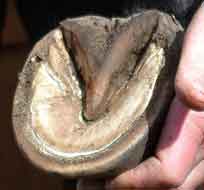
The barefoot movement and its veterinary researchers have found a good indicator for whether a hoof is well-trimmed overall.
Traditionally, people understood the importance of breakover to a horse's best athletic movement and to long-term soundness. Since the early 1900's, when cars replaced horses as the main means of transportation, this understanding got lost. The movement of most horses deteriorated as the "long-heeled" trim became the style in farrier schools. In recent decades, many of us have almost never seen a horse moving well. When I first saw my horse’s feet start to land correctly, I thought it looked "artificial"!
The indicator of a good trim is that when going on level ground, the front feet land heel-first. Just before the heel lands, you can see the foot "flip" forward as all joints in the leg go into complete extension.
In a horse with late breakover, the toe lands first, or the foot may land flat. With toe-first landing, you will see a little “wiggle” in the pastern bones -- you can almost hear them go "ka-chunk" -- as the horse puts weight on the foot.
(Note: The hind leg joints bend differently from the front leg joints, so that the hind leg lands heel-first unless the foot is very badly balanced. When I talk about how to trim a foot to get it to land heel-first, I am talking about the front feet. We don't trim the hind feet this way because they don't need it, except in the unusual situation where the toe has gone long-out-in-front; in this case we can use the trim method temporarily until the toe has been backed-up closer to the coffin bone.)
We can see the difference between heel-first and
toe-first landing by walking the horse downhill and then uphill on a slight
slope.
 |
Watch your horse walking downhill. There is plenty of time for the front leg to extend fully before it reaches the ground. You will see the foot "flip" forward as every joint extends fully, and then the hoof will touch the ground heel-first. |
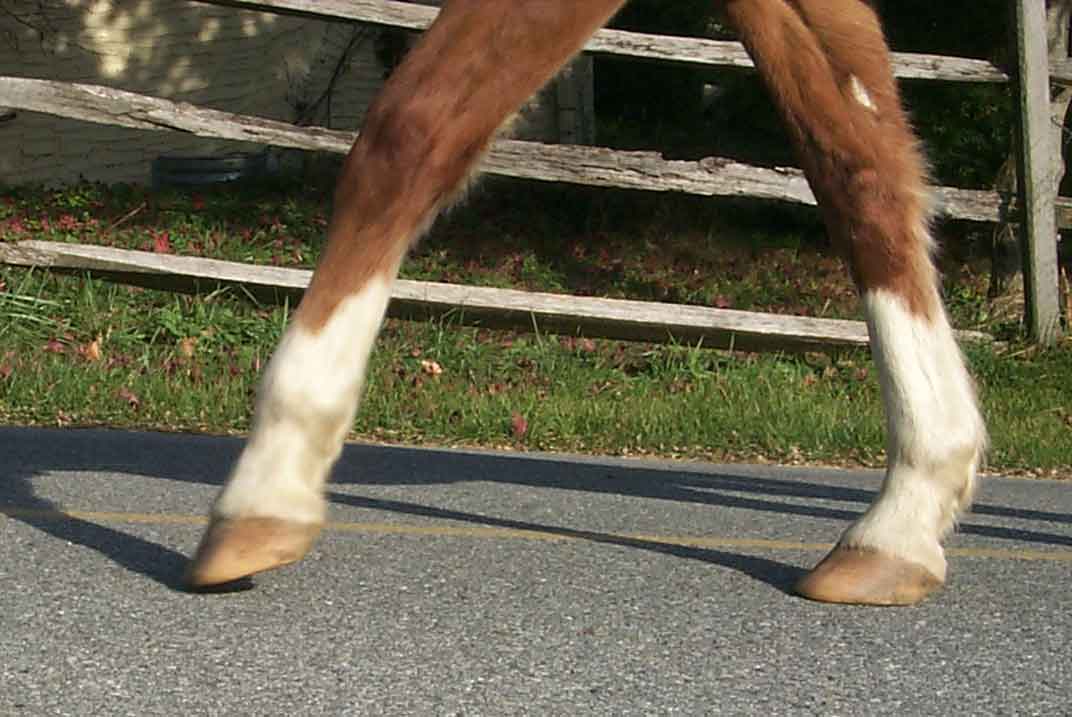 |
Walking uphill to show what a toe-first landing looks like. None of the foreleg joints are in full extension -- there is not enough time for the leg to extend fully before the ground arrives. The toe touches first and then you will see a navicular-stressing "wiggle" or "ka-chunk!" in the pastern bones as the horse weights the foot. |
Now, to discover whether your horse is "officially" landing heel-first or toe-first, watch him walking on level ground, and notice how the front feet are landing. Sometimes they land exactly flat, which is better than toe-first, but can be improved further by trimming as I will show below.
What is breakover?
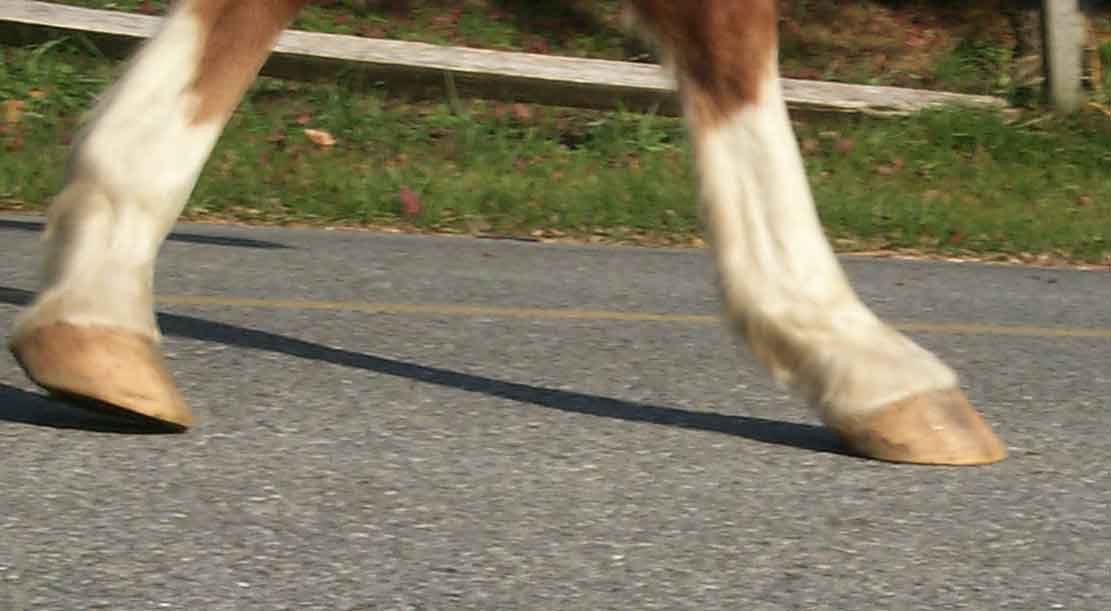 |
Breakover is:
1) the moment in time when the foot starts to tip forward to lift off from the ground. The heel begins to lift off the ground at the back end of the stride. (Here the horse is turning and breaking over slightly away from the camera.) |
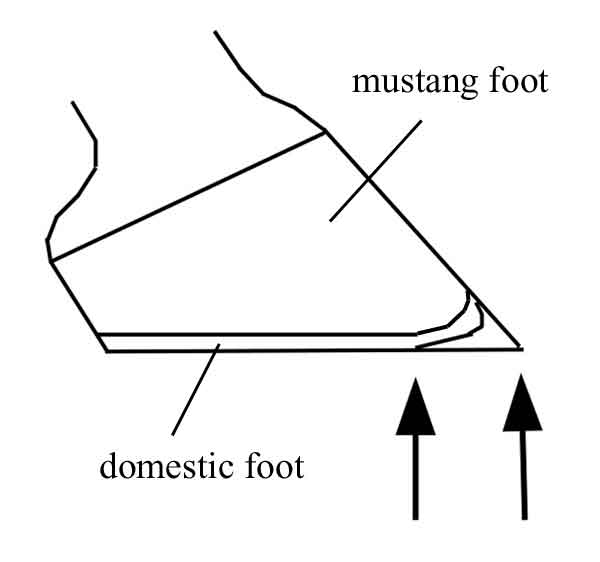 |
2) the position of a line across the toe,
indicating where the foot is able to tip forward for liftoff.
Right arrow shows where the breakover is on a flat-bottom trim. If the toe is flared, breakover may be even farther out in front. Breakover is delayed and the leg only has time for a shortened stride and a toe-first landing. Left arrow shows where the breakover line is when trimmed with a mustang roll. Note that the breakover is in the same position as in the shorter mustang foot (inner hoof outline) with naturally rolled toe. When the breakover is in this position, the leg has time to swing all the way forward to full extension, and can land heel-first. |
What does breakover have to do with heel-first landing?
The location of breakover determines whether the foot will have time in the forward stride to land heel-first, or not. If the toe is long-in-front (forward flare), delaying breakover, the foreleg does not have time to swing far enough forward to land heel-first -- like walking uphill -- and will land toe-first instead; the entire gait is shortened.
Delay in breakover also causes forging
(hind foot hits the forefoot) because the forefoot doesn’t get out
of the way in time for the hind foot to land on the same spot.
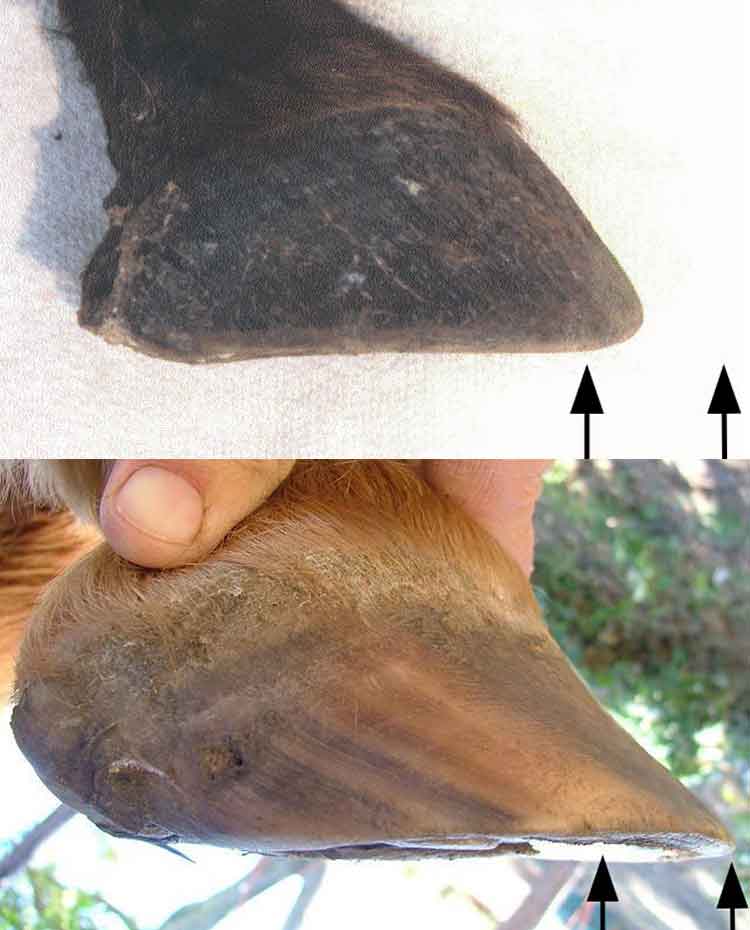 |
A wild mustang hoof (upper photo). Left arrow
shows where breakover occurs on this naturally-worn foot.
A domestic hoof with flared toe (lower photo). Right arrow shows the breakover at the very front of a flared toe with flat-bottom trim. |
Why do we want a correct breakover?
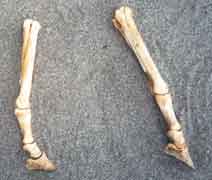 |
When the foot lands toe-first, the pastern bones must change from an upward curve as the toe lands, to a downward curve when the foot becomes weight-bearing. |
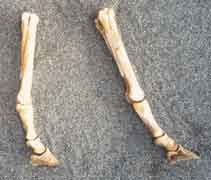 |
When the foot lands heel-first, the pastern bones are already in a downward curve (full extension of the joints) and the curve doesn't have to change orientation when the foot becomes weight-bearing. |
Everything about the horse's hoof works better when the foot lands on the ground heel-first. The hoof capsule flexes in such a way that you get the best shock absorption, the best circulation, and balanced wear. The digital cushion is tough and the frog and heels are wide; they are able to protect the foot from amazing amounts of hard work.
The horse's movement, when the front feet can land heel-first, is big and free.
When the foot lands toe-first, none of these things work well.
- -- shock absorption is reduced,
-- there is less circulation inside the hoof (due to flexing differently),
-- the toe tends to flare forward so that the heels become contracted,
-- the hoof wears unevenly.
In addition, the "wiggle" in the pastern bones puts incorrect stress on the impar ligament, which holds the navicular bone in position. The impar ligament gets inflamed from constant toe-first landing. This inflammation, in Bowker's and Ovnicek's opinion, can lead eventually to "navicular syndrome" and/or coffin-joint disease.
What balance does the foot need to land heel-first?
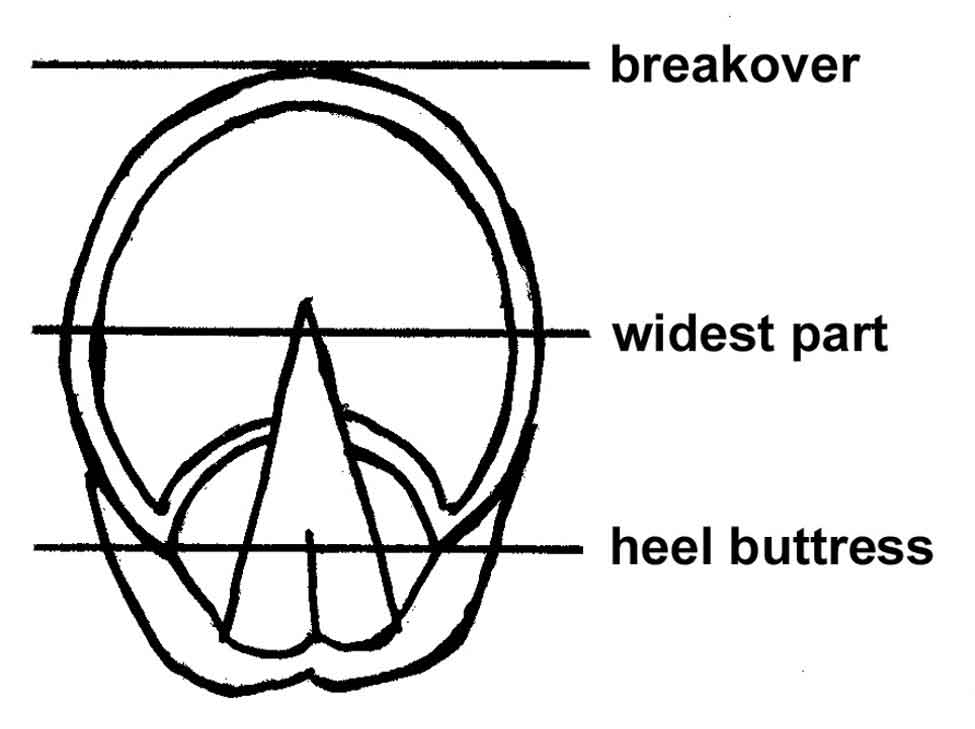
In order to land heel-first, the hoof must have
a correct toe-to-heel balance. The best proportion, in a front foot, is
about 1/3 from breakover to widest part of the hoof, and 2/3 from the widest
part to the heel buttress. In hooves that land toe-first, the toe section
is typically longer (2/3) than the heel section (1/3).
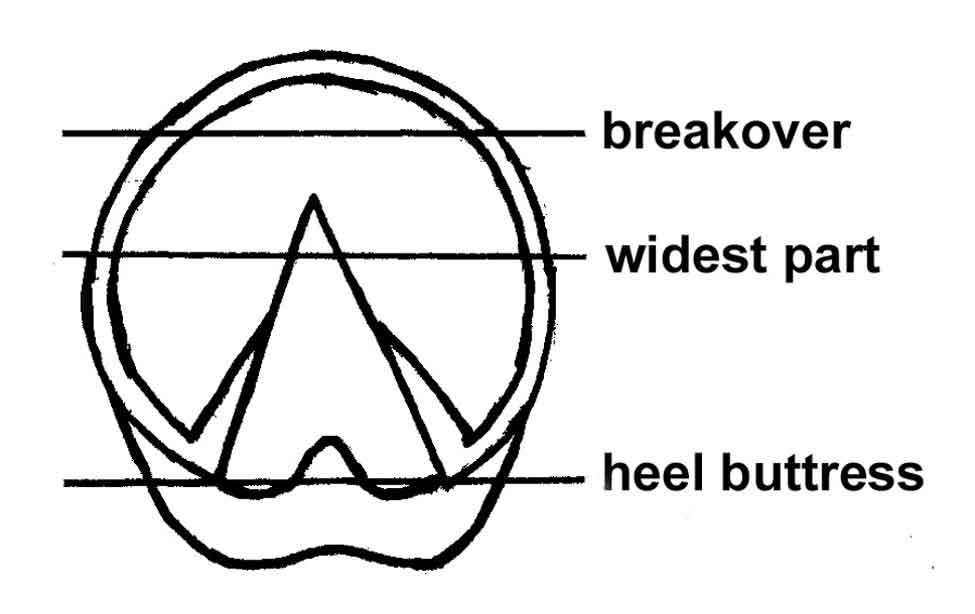 |
A hoof balanced for heel-first landing.
The distance from the breakover line to the widest part of the hoof is shorter than the distance from the widest part to the heel buttresses. |
 |
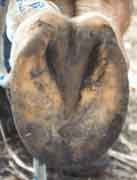
An imbalanced hoof with long heels (which moves
the buttresses forward) and a flared toe (which moves the breakover forward).
The"widest part" stays at about the same place.
The distance from the breakover line to the widest part of the hoof is longer than the distance from the widest part to the heel buttresses. |
 |
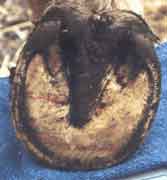 |
My gelding's foot:
To show how a foot changes its proportions, here is a front foot, before and after backing up the toe for about 2 months. The heels have spread 3/4 inch (2 cm) and the amount of toe in front of the frog has gotten shorter. Note that the outline of the foot has changed from an oval to nearly round. |
Overall soundness
When a hoof is consistently landing heel-first, its entire physiology and its flexion are able to work the best. Trim problems that we have not been able to fix seem to resolve on their own.
- -- A coffin bone that is sitting crooked inside
the hoof capsule will level itself over several months without our frustrated
efforts to "make it level."
-- "Unidentified heel pain" or "navicular" pain from an inflamed impar ligament disappears.
-- Contracted heels widen. In my two horses, all of the heels became 1/2 to 3/4 inch (1.5 to 2 cm) wider, measuring between the buttresses, within a couple of months. The outline, which had been oval for years, became nearly round.
-- The digital cushion becomes tougher so that the horse can go more comfortably on rough ground.
-- And the great delight: riders are reporting to me that "My horse now has big 'dressage-y' movement, he's such fun to ride!"